| Welcome, Guest |
You have to register before you can post on our site.
|
| Forum Statistics |
» Members: 74
» Latest member: Tomo
» Forum threads: 47,413
» Forum posts: 47,419
Full Statistics
|
| Online Users |
There are currently 133 online users.
» 0 Member(s) | 124 Guest(s)
Ahrefs, Amazon, Bing, Claude, Google, MJ12, OpenAI, Semrush, Sogou
|
| Latest Threads |
Identifying and Sourcing ...
Forum: Parts , Attachments & Tools
Last Post: MikePhua
01-07-2026, 06:29 PM
» Replies: 0
» Views: 463
|
Cat 931B Brake Parts
Forum: Parts , Attachments & Tools
Last Post: MikePhua
01-07-2026, 06:29 PM
» Replies: 0
» Views: 271
|
Choosing Between Cat 228,...
Forum: General Discussion
Last Post: MikePhua
01-07-2026, 06:28 PM
» Replies: 0
» Views: 483
|
Fix It or Part It Out
Forum: General Discussion
Last Post: MikePhua
01-07-2026, 06:27 PM
» Replies: 0
» Views: 337
|
Hydraulic Delay When Lowe...
Forum: Troubleshooting & Diagnosing
Last Post: MikePhua
01-07-2026, 06:27 PM
» Replies: 0
» Views: 421
|
Bale Chopper and Mulcher ...
Forum: General Discussion
Last Post: MikePhua
01-07-2026, 06:26 PM
» Replies: 0
» Views: 296
|
Mini UC Maintenance
Forum: General Discussion
Last Post: MikePhua
01-07-2026, 06:25 PM
» Replies: 0
» Views: 286
|
Locating Wiring Informati...
Forum: General Discussion
Last Post: MikePhua
01-07-2026, 06:24 PM
» Replies: 0
» Views: 321
|
Case Industrial Brown Sub...
Forum: Parts , Attachments & Tools
Last Post: MikePhua
01-07-2026, 06:23 PM
» Replies: 0
» Views: 262
|
Dirt Work in West Virgini...
Forum: Construction & Urban Infrastructure Forum
Last Post: MikePhua
01-07-2026, 06:23 PM
» Replies: 0
» Views: 355
|
|
|
| Why Is the Coolant Temperature Gauge on the Volvo EC140BLC Not Responding Properly |
|
Posted by: MikePhua - 08-27-2025, 04:07 PM - Forum: Troubleshooting & Diagnosing
- No Replies
|
 |
The Volvo EC140BLC Excavator and Its Electrical Backbone
The Volvo EC140BLC is a mid-size hydraulic excavator introduced in the early 2000s as part of Volvo Construction Equipment’s B-Series lineup. Designed for versatility in urban construction, forestry, and utility work, the EC140BLC features a 4-cylinder Volvo D4D engine producing approximately 98 horsepower, paired with a load-sensing hydraulic system and electronically managed controls. Volvo CE, a division of the Swedish Volvo Group, has long emphasized operator comfort, fuel efficiency, and modular electronics in its machines. By 2010, the EC140BLC had sold thousands of units globally, particularly in Europe and North America, where its compact footprint and reliability made it a favorite among contractors.
One of the defining features of the EC140BLC is its integrated electronic control architecture, which includes: - Engine ECU (Electronic Control Unit): Manages engine performance, fuel injection, and sensor inputs.
- VECU (Vehicle ECU): Oversees non-engine functions such as lighting, gauges, and auxiliary systems.
- IECU (Instrument ECU): Controls the display panel and communicates with other ECUs via CAN bus.
This layered control system allows for modular diagnostics and streamlined troubleshooting—but it also introduces complexity when faults arise.
Symptoms of a Faulty Coolant Temperature Gauge
In a documented case, an EC140BLC exhibited a persistent issue where the coolant temperature gauge displayed only a single bar, regardless of engine temperature. Upon startup, the gauge would perform its sweep test (a standard self-check), but then settle at the lowest reading. Technicians verified that the sensor received a 5V reference signal and that jumping the sensor wires dropped the voltage to 0V—yet the gauge remained unchanged.
This behavior suggests that the sensor circuit is functioning electrically, but the signal is not being interpreted or transmitted correctly to the display. The most likely culprits include:- Faulty coolant temperature sensor
- Damaged wiring or connectors
- Failed VECU or IECU
- CAN bus communication fault
Understanding the CAN Bus and ECU Communication
The EC140BLC uses a Controller Area Network (CAN bus) to link its ECUs. This digital communication protocol allows multiple microcontrollers to exchange data without a central computer. In this system:- The coolant temperature sensor sends analog data to the Engine ECU.
- The Engine ECU digitizes the signal and transmits it via CAN bus to the VECU.
- The VECU relays the data to the IECU, which drives the gauge.
If any link in this chain fails, the gauge may not respond. Twisted-pair wires are typically used for CAN bus lines to reduce electromagnetic interference. In this case, the absence of twisted wires at the monitor panel suggests a possible break or misrouting in the communication path.
Sensor Behavior and Diagnostic Techniques
Coolant temperature sensors are thermistors—resistors that change value with temperature. Most use a negative temperature coefficient (NTC), meaning resistance decreases as temperature rises. A typical sensor will show:- ~5V at cold start (high resistance)
- ~0.5–1.5V at operating temperature (low resistance)
Jumping the sensor wires simulates a high-temperature condition. If the gauge does not respond, the issue lies beyond the sensor. Technicians can use a multimeter to measure voltage drop across the sensor and compare it to expected values. An infrared thermometer can also verify actual coolant temperature at the thermostat housing.
VECU and IECU Failure Modes
The VECU and IECU are solid-state modules that can fail due to:- Moisture ingress
- Voltage spikes
- Software corruption
- Connector oxidation
In one case from a Canadian rental fleet, a Volvo EC140BLC experienced intermittent gauge failures during spring thaw. Moisture had seeped into the VECU housing, causing erratic CAN bus signals. After replacing the VECU and resealing the harness connectors, the issue was resolved.
Schematics and Troubleshooting Strategy
To diagnose gauge faults in the EC140BLC, technicians should follow a structured approach:
- Verify sensor voltage
- Confirm 5V reference and variable output
- Jump sensor wires
- Inspect wiring harness
- Look for corrosion, breaks, or loose pins
- Check CAN bus continuity
- Use an oscilloscope or CAN diagnostic tool
- Swap ECUs if available
- Substitute known-good VECU or IECU
- Review schematics
- Trace signal path from sensor to gauge
Volvo’s Prosis system provides wiring diagrams, but older versions may lack clarity. Technicians often rely on field experience and visual inspection to supplement schematic gaps.
Preventive Measures and Long-Term Solutions
To minimize electrical faults in excavators like the EC140BLC, operators and fleet managers should implement:- Regular connector cleaning with dielectric grease
- ECU housing inspection for cracks or seal failure
- Battery voltage monitoring to prevent surges
- CAN bus shielding in high-interference zones
- Software updates during scheduled service
According to a 2023 reliability study, electronic faults accounted for 38% of downtime in mid-size excavators, with sensor and ECU issues leading the list.
Conclusion
The coolant temperature gauge issue in the Volvo EC140BLC highlights the challenges of diagnosing faults in electronically integrated machines. While the sensor circuit may appear functional, failures in ECU communication or CAN bus integrity can render the gauge inoperative. By combining electrical testing, schematic review, and field wisdom, technicians can pinpoint the root cause and restore accurate temperature monitoring. As equipment becomes increasingly digital, the ability to navigate layered control systems will be essential for effective maintenance and repair.
|

|
|
| Case 580E Injector Linkage Failure and Repair |
|
Posted by: MikePhua - 08-27-2025, 04:04 PM - Forum: Troubleshooting & Diagnosing
- No Replies
|
|
Machine Background
The Case 580E is a widely used loader-backhoe known for its reliable performance in the construction and agricultural sectors. Its diesel engine is coupled with a mechanically actuated injector pump, which relies on precise linkage to regulate fuel delivery and maintain engine performance.
Injector Linkage Failure
The injector linkage in the Case 580E controls fuel injection timing and quantity by mechanically adjusting the injector pump. Failure of this linkage—such as coming unscrewed, breaking, or becoming disconnected—results in immediate engine shutdown or failure to start.
A common scenario involves the linkage unexpectedly detaching during operation. While reconnecting the linkage may temporarily restore function, persistent or advanced damage often prevents normal operation thereafter.
Symptoms and Diagnosis - Sudden engine shutdown or failure to start.
- Inability to control engine speed or throttle response.
- Visible disconnection or looseness in linkage components.
- Abnormal engine noises or difficulty maintaining idle.
- Difficulty in reconnecting or loosening of linkage components after repair.
Repair and Maintenance- Inspect the entire linkage assembly for missing fasteners, bent rods, and worn bushings.
- Replace any faulty components and properly tighten all connectors using recommended torque specifications.
- If linkage repeatedly loosens, consider thread-locking compounds or replacing damaged threads.
- Some repairs require partial disassembly of the injector pump cover or linkage arms for internal inspection.
- Regular lubrication and preventative maintenance improve linkage durability and reduce failure risk.
Additional Injector Pump Considerations- Injector pumps prone to leaks, especially at throttle shafts or seals, are best serviced with OEM gasket and seal kits.
- Proper setting of engine timing relative to injector pump position is critical during pump rebuild or linkage repair.
- Fuel system bleeding should follow manufacturer procedure after injector components are disturbed to ensure air-free operation.
- Testing injectors outside of the engine helps verify spray pattern, opening pressure (typically near 2800 psi), and leak-off rates, important for diagnosing poor engine performance.
Glossary of Terms- Injector Pump: Fuel delivery unit regulating timing and quantity of diesel injection.
- Linkage: Mechanical connection components transferring throttle input to the pump.
- Throttle Shaft: Pivoting shaft controlling injection on the pump.
- Leak-Off: Amount of fuel returning to the tank, indicating injector sealing condition.
- Torque Specifications: Manufacturer recommended tightness levels to prevent loosening or damage.
Conclusion
Failure of the injector linkage on the Case 580E can abruptly halt operations but is often repairable with careful diagnosis and component replacement. Proper linkage reattachment demands thorough checking of mechanical conditions and adherence to specifications. Additionally, attention to injector pump seals, timing, and fuel system bleeding complements linkage repairs to restore reliable engine performance. These practices, combined with preventive maintenance, ensure operational longevity and minimize unexpected downtime.
|
|
|
|
| CAT or Volvo Which Brand Delivers Better Value in Heavy Equipment |
|
Posted by: MikePhua - 08-27-2025, 04:04 PM - Forum: General Discussion
- No Replies
|
|
The Global Giants Behind the Machines
Caterpillar and Volvo Construction Equipment represent two of the most influential forces in the global heavy machinery market. Caterpillar, founded in 1925 in California, has long been synonymous with earthmoving and mining equipment. With over 100 manufacturing facilities and a presence in more than 180 countries, CAT has sold millions of machines across its product lines. Its reputation is built on durability, parts availability, and a vast dealer network.
Volvo CE, a division of the Swedish Volvo Group, entered the construction equipment sector in the 1950s and quickly gained traction with its focus on operator comfort, fuel efficiency, and advanced hydraulics. Volvo’s acquisition of Samsung Heavy Industries’ equipment division in 1998 expanded its reach into Asia, and its partnership with SDLG further strengthened its global footprint. Volvo CE now ranks among the top five construction equipment manufacturers worldwide.
Comparing Excavators CAT 323 vs Volvo EC250EL
The CAT 323 is a 23-ton class excavator powered by a 172 hp engine, designed for high production in general construction. It features CAT’s Smart Mode system, which automatically adjusts engine and hydraulic power to match the task, reducing fuel consumption by up to 25%. The machine also includes CAT Grade with 2D and payload monitoring, enhancing precision and efficiency.
The Volvo EC250EL, slightly heavier at 26 tons, offers a 215 hp engine and advanced electrohydraulic controls. Volvo’s ECO mode and auto-idle features contribute to fuel savings, while its CareTrack telematics system allows remote monitoring of performance and maintenance needs. Operators often praise the EC250EL for its smooth controls and spacious cab.
In side-by-side comparisons, the EC250EL tends to outperform in fuel efficiency and operator comfort, while the CAT 323 excels in integrated technology and dealer support. According to a 2023 contractor survey in Europe, Volvo excavators averaged 12% lower fuel consumption than comparable CAT models under similar workloads.
Wheel Loaders CAT 950M vs Volvo L110H and L120H
The CAT 950M is a 230 hp wheel loader with a 3.5–4.0 cubic yard bucket capacity. It features CAT’s Performance Series buckets, optimized for faster fill times and reduced fuel burn. The loader uses a torque converter transmission and includes CAT Payload for onboard weighing.
Volvo’s L110H and L120H are 188 hp and 211 hp loaders respectively, both equipped with Volvo’s OptiShift transmission and Reverse By Braking technology. These features reduce fuel use and wear on components. The L120H offers a bucket capacity of up to 4.2 cubic yards, slightly edging out the CAT 950M in volume.
Volvo claims up to 15% better fuel efficiency over comparable CAT models, a figure supported by independent tests in Scandinavian quarries. Operators often report smoother ride quality and quieter cabins in Volvo loaders, while CAT machines are favored for their ruggedness and parts availability.
Dozer Comparison CAT D5 and Volvo Alternatives
The CAT D5 is a mid-size dozer with a 170 hp engine and a weight of around 42,000 lbs. It features CAT’s Stable Blade and Slope Assist technologies, which help operators maintain grade and reduce rework. The D5’s elevated sprocket design improves balance and component life.
Volvo does not currently offer a direct competitor in the dozer category, having exited that segment years ago. Contractors seeking Volvo alternatives often turn to Liebherr or Komatsu. However, the CAT D5 remains a benchmark in its class, with over 5,000 units sold globally since its redesign in 2020.
Dealer Support and Parts Availability
One of the most decisive factors in equipment selection is dealer support. CAT’s global dealer network is unmatched, with over 160 dealers and thousands of service locations. This ensures rapid parts delivery and access to factory-trained technicians.
Volvo CE also maintains a strong dealer presence, particularly in Europe and North America. However, in some regions, parts availability and service response times may lag behind CAT. A 2022 fleet manager survey found that 78% of respondents ranked dealer support as more important than initial machine performance when choosing a brand.
Operator Experience and Ergonomics
Volvo machines are widely praised for their operator-centric design. Features like adjustable controls, panoramic visibility, and low cabin noise contribute to reduced fatigue and higher productivity. CAT has made strides in this area, especially with its Next Gen excavators and M Series loaders, but Volvo still leads in perceived comfort.
In a Canadian asphalt plant, operators reported preferring the Volvo L110H over a CAT 950M due to smoother controls and less vibration during long shifts. This feedback led the company to standardize on Volvo for future loader purchases.
Emissions and Compliance
Both CAT and Volvo offer Tier 4 Final compliant machines with diesel particulate filters (DPF) and selective catalytic reduction (SCR) systems using DEF (diesel exhaust fluid). Volvo’s systems are known for fewer regeneration cycles and less downtime, while CAT’s Emissions Module is integrated into its machine diagnostics for easier troubleshooting.
In colder climates, DEF contamination can cause issues in both brands. A quarry in northern Ontario experienced DEF crystallization in a Volvo L180H during winter plowing, traced back to bulk DEF storage errors. After switching to sealed containers and installing DEF heaters, the problem was resolved.
Recommendations for Buyers
When choosing between CAT and Volvo, consider the following: - Dealer proximity and service quality
- Operator feedback and comfort preferences
- Fuel efficiency under typical workloads
- Technology integration and telematics needs
- Parts availability and long-term support
For mixed fleets, standardizing on one brand can simplify training and maintenance. However, some contractors prefer a hybrid approach, using Volvo for loaders and CAT for dozers and excavators.
Conclusion
CAT and Volvo each bring distinct strengths to the table. CAT offers unmatched dealer support, rugged designs, and integrated technology, while Volvo excels in fuel efficiency, operator comfort, and smooth hydraulics. The best choice depends on local support, application needs, and operator preferences. In today’s competitive market, the brand that delivers uptime, efficiency, and comfort will earn long-term loyalty.
|
|
|
|
| Why Is the Caterpillar 938M Overheating Despite a Full Coolant System |
|
Posted by: MikePhua - 08-27-2025, 04:02 PM - Forum: Troubleshooting & Diagnosing
- No Replies
|
|
The Legacy of the 938M Wheel Loader
The Caterpillar 938M is part of Cat’s M Series wheel loader lineup, introduced in the early 2010s to replace the H Series. Designed for mid-size earthmoving, aggregate handling, and industrial applications, the 938M quickly became a favorite among fleet operators for its fuel efficiency, operator comfort, and advanced hydraulic systems. Caterpillar, founded in 1925, has long dominated the global heavy equipment market, and the 938M reflects its commitment to integrating Tier 4 Final emissions compliance with practical field performance.
By 2020, Caterpillar had sold tens of thousands of M Series loaders worldwide, with the 938M accounting for a significant share in North America and Europe. Its 188-horsepower Cat C7.1 ACERT engine, combined with a load-sensing hydraulic system and electronically controlled cooling fan, made it a versatile choice for contractors and municipalities alike.
Symptoms of Overheating in a 2015 938M
In one documented case, a 2015 model began exhibiting rapid coolant temperature rise immediately upon startup. The temperature would start above 100°F and climb steadily until reaching 250°F, triggering alarms and shutdown protocols. The radiator had already been cleaned, and the coolant level was verified as full. This points to a deeper issue beyond basic maintenance.
Understanding the Cooling System Architecture
The 938M uses a pressurized liquid cooling system with the following key components: - Radiator core: Transfers heat from coolant to ambient air.
- Thermostat: Regulates coolant flow based on engine temperature.
- Temperature sensor: Sends data to the ECM (Electronic Control Module).
- Electric cooling fan: Variable-speed, controlled by ECM based on temperature and load.
- Water pump: Circulates coolant through the engine and radiator.
When any of these components fail or misreport, the system can behave erratically. In this case, the rapid temperature rise suggests either a faulty sensor or a circulation issue.
Sensor Failure and False Readings
Temperature sensors in modern equipment are solid-state devices that convert thermal energy into electrical signals. A failing sensor may:- Report incorrect temperatures
- Trigger premature fan activation or shutdown
- Cause ECM to mismanage cooling cycles
In the 938M, the primary coolant temperature sensor is located near the thermostat housing at the front of the cylinder head. If this sensor malfunctions, it can falsely report high temperatures even when the coolant is within normal range.
A quick diagnostic method is to use an infrared thermometer to compare actual surface temperatures with sensor readings. If the sensor reports 250°F but the head surface is only 180°F, the sensor is likely faulty.
Thermostat and Circulation Issues
Another possibility is a stuck thermostat. If the thermostat remains closed, coolant cannot circulate through the radiator, causing localized overheating. Symptoms include:- Hot engine block
- Cool radiator hoses
- No temperature drop across radiator
Replacing the thermostat is a straightforward fix, but it’s often overlooked when sensors are suspected first.
Fan Control and ECM Behavior
The 938M’s cooling fan is electronically controlled and adjusts speed based on temperature, engine load, and ambient conditions. If the ECM receives faulty data, it may fail to activate the fan or run it at insufficient speed. This can be caused by:- Sensor failure
- Wiring issues
- ECM software glitches
In 2021, Caterpillar issued a service bulletin for intermittent fan control issues in certain M Series loaders, recommending ECM reprogramming and sensor replacement.
Field Anecdote from a Quarry Operation
In a limestone quarry in Indiana, a 938M began overheating during early morning shifts. Mechanics discovered that the ambient temperature sensor was misreporting cold conditions, causing the fan to run at low speed despite rising engine temps. After replacing the sensor and updating the ECM firmware, the issue was resolved. This highlights the importance of cross-checking multiple sensor inputs.
Recommended Diagnostic Steps
To troubleshoot overheating in a 938M, technicians should follow this sequence:
- Verify coolant level and condition
- Look for contamination, air bubbles, or oil residue
- Check radiator and airflow
- Clean fins, inspect fan blades, confirm unobstructed airflow
- Test temperature sensor accuracy
- Use infrared thermometer to compare readings
- Inspect thermostat operation
- Remove and test in hot water bath for proper opening
- Scan ECM for fault codes
- Use Cat ET or compatible diagnostic tool
- Monitor fan behavior
- Confirm variable speed response to temperature changes
Preventive Measures and Long-Term Solutions
To avoid overheating issues, operators should implement the following:- Regular sensor calibration checks every 500 hours
- Coolant flush and replacement every 2,000 hours or annually
- Radiator cleaning with compressed air or water monthly
- Fan motor inspection for wear and electrical faults
- Software updates during scheduled maintenance
According to a 2023 fleet reliability survey, 72% of overheating incidents in Tier 4 Final machines were linked to electronic sensor faults rather than mechanical failures.
Conclusion
The overheating issue in the Caterpillar 938M, especially when coolant levels are normal and the radiator is clean, often stems from sensor inaccuracies or thermostat malfunction. With the increasing reliance on electronic controls in modern loaders, traditional mechanical diagnostics must be paired with digital verification. By combining field wisdom with structured troubleshooting, operators can restore performance and prevent costly downtime.
|
|
|
|
| Caterpillar D5B Dozer |
|
Posted by: MikePhua - 08-27-2025, 04:02 PM - Forum: General Discussion
- No Replies
|
|
Heritage and Manufacturing Context
The Caterpillar D5 lineage stretches back to 1939, with the reintroduction of the D5B model in 1977. This machine evolved from earlier versions and was built to combine durability and manageable power. The D5B typically housed a 201 cubic inch (3.3 L) six-cylinder diesel engine—later referred to as the 3306—with a power output of about 105 horsepower (78 kW) . Production continued into the mid-1980s, with many units manufactured by Caterpillar–Mitsubishi and distributed globally .
Specifications and Mechanical Traits
Here are its key characteristics, presented clearly and compactly: - Operating Weight: Approximately 20,400 to 25,800 pounds (9,265–11,700 kg)
- Blade Width: Around 10.4 feet (3 m), ideal for efficient material moving
- Dimensions:
- Length with blade: ~15.1 ft (4.6 m)
- Width over tracks: ~7.75 ft (2.36 m)
- Height at cab/top: ~9.09 ft (2.77 m)
- Fuel and Hydraulics:
- Fuel capacity: ~65 gallons (246 L)
- Hydraulic system: 13 gallons, operating at ~2,250 psi (155 bar), with ~43 gpm (163 L/min) pump flow
- Transmission: Offered in both a five-speed direct drive and a three-speed powershift to suit different operator preferences
These features illustrate a machine that balances manageable weight with respectable power and efficiency.
Strengths and Field Impressions
Operators recall the D5B as a stable and capable dozer, especially suited for tasks such as land clearing, secondary bush operations, and light farm work. One user reminisced about clearing dense pine and scrub growth, noting the D5B’s robustness and consistent performance even in challenging ground conditions .
Another veteran shared, “With a heavy cultivator on wet ground, traction becomes critical—especially when using narrow 16-inch tracks, which tend to sink under pressure. That’s where you need to manage your gear selection carefully to preserve mobility” .
These anecdotes highlight how the D5B excelled in real-world, demanding environments—offering reliability and ruggedness in compact form.
Weaknesses and Maintenance Considerations
A recurring issue noted by operators involves the final drives. These mechanical components often showed wear signs, and early inspection is advised. Draining and examining the oil in the final drives for metal shavings or discoloration is considered essential preventive maintenance . Addressing this early can prevent costly failures later on.
Another operator emphasized the lack of engine braking in powershift variants—meaning operators must rely heavily on standard braking systems on steep grades .
Practical Data Summary- Operating weight: 20,400–25,800 lbs
- Engine: ~105 hp, Caterpillar 3306 diesel
- Blade width: ~10.4 ft
- Fuel capacity: ~65 gallons
- Hydraulic capacity: ~13 gallons
- Transmission: Direct drive or powershift
- Compact dimensions make it easily transportable
Field Stories and Reliability
One memorable adventure involved a D5B configured with a wide track and rake attachment, operating relentlessly in South Florida’s sandy muck, clearing acres of plantation terrain. The operator estimated clearing about 4 acres a day—an impressive feat that speaks volumes about the machine’s endurance and adaptability .
Recommendations for Operators- Inspect final drives regularly, checking oil for metal and signs of wear.
- Match track width to ground conditions—wide tracks help prevent sinking in soft soil.
- Be aware of transmission capabilities—powershift units lack engine braking; plan operations accordingly.
- Maintain hydraulic and fuel systems consistently, and ensure the undercarriage remains clean and tensioned properly.
Summary
The Caterpillar D5B bulldozer shines as a compact, straightforward, and effective crawler—offering a reliable 105 hp powerplant, durable transmission options, and a versatile blade, wrapped in transport-friendly dimensions. Built in the late 1970s and '80s, it serves as a testament to Caterpillar’s engineering philosophy: rugged dependability in a manageable footprint. While final-drive issues and transmission-specific traits merit attention, a well-maintained D5B continues to act as a trusted companion in rough terrain and demanding tasks.
|
|
|
|
| Comprehensive Guide to the 2012 Caterpillar 236B3 Skid Steer Loader |
|
Posted by: MikePhua - 08-27-2025, 04:01 PM - Forum: General Discussion
- No Replies
|
|
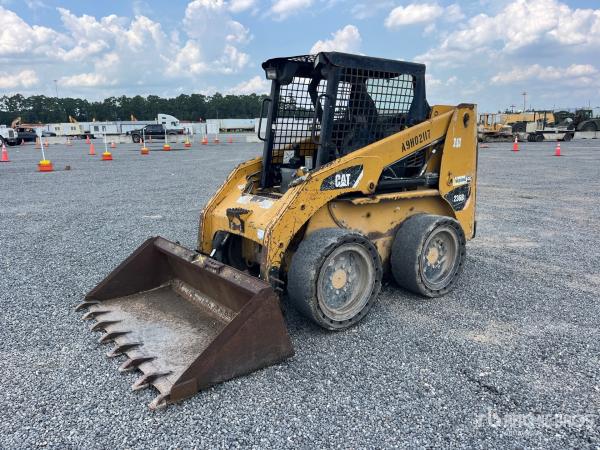
Introduction
The 2012 Caterpillar 236B3 Skid Steer Loader is a compact yet powerful machine designed to tackle a variety of tasks in construction, landscaping, and agriculture. Known for its maneuverability and versatility, the 236B3 has become a popular choice for operators seeking efficiency in confined spaces.
Engine Specifications - Engine Model: Caterpillar C3.4 DIT
- Gross Power: 74 hp (55 kW)
- Displacement: 3.4 liters
- Fuel Type: Diesel
This engine provides the necessary power to handle demanding tasks while maintaining fuel efficiency.
Dimensions and Capacities- Operating Weight: 7,007 lbs (3,175 kg)
- Length with Bucket: 11.54 ft (3.52 m)
- Width Over Tires: 5.5 ft (1.68 m)
- Height to Top of Cab: 6.87 ft (2.09 m)
- Wheelbase: 3.73 ft (1.13 m)
- Rated Operating Capacity: 1,950 lbs (884 kg)
- Tipping Load: 3,900 lbs (1,769 kg)
- Fuel Tank Capacity: 23.8 gal (90 L)
- Hydraulic System Fluid Capacity: 13.7 gal (52 L)
- Hydraulic Tank Capacity: 9.2 gal (35 L)
These dimensions make the 236B3 suitable for a wide range of applications, offering a balance between power and compactness.
Hydraulic System- Pump Flow Capacity: 22 gal/min (83.3 L/min)
- Relief Valve Pressure: 3,335 psi (23.0 MPa)
- Hydraulic Power: 42.8 hp (31.9 kW)
The hydraulic system's design ensures efficient operation of attachments, contributing to the loader's versatility.
Operator Comfort and Controls
The 236B3 features an ergonomic operator station with easy-to-use joystick controls, providing comfort during extended work hours. The spacious cabin, available with optional air conditioning, enhances operator comfort in various working conditions.
Lift Path and Attachments
The radial lift design of the 236B3 provides excellent digging performance and lifting capabilities. This design is ideal for tasks such as digging, grading, and material handling. The machine is compatible with a wide range of attachments, including buckets, forks, and grapples, enhancing its versatility.
Maintenance and Durability
Caterpillar's commitment to durability is evident in the 236B3's construction. The machine is designed for easy maintenance, with accessible service points and long service intervals. Regular maintenance ensures the longevity and reliability of the loader.
Conclusion
The 2012 Caterpillar 236B3 Skid Steer Loader is a robust and versatile machine, well-suited for a variety of tasks in demanding environments. Its combination of power, compact size, and operator comfort makes it a valuable asset for professionals in construction and agriculture.
|
|
|
|
| Motor Overloading in Heavy Equipment Operation |
|
Posted by: MikePhua - 08-27-2025, 04:00 PM - Forum: Troubleshooting & Diagnosing
- No Replies
|
|
Overview of Motor Overloading
Motor overloading occurs when an electric or hydraulic motor is subjected to a load exceeding its design capacity for an extended period, resulting in excessive heat buildup, loss of efficiency, damage, or failure. It is a common issue in heavy equipment, impacting reliability, safety, and operational costs.
Common Causes of Motor Overloading - Excessive Load: Mechanical jamming, sudden high torque demands, or continuous heavy loads beyond the motor’s rated torque cause overstrain.
- Electrical Supply Issues: Low or fluctuating voltage supply reduces motor efficiency, leading to increased current draw to maintain load, accelerating overload.
- Poor Heat Dissipation: Inadequate ventilation or high ambient temperature prevents effective cooling, causing internal temperature rise and insulation breakdown.
- Mechanical Failures: Bearing wear, rotor imbalance, or friction can impose additional mechanical load causing premature overload.
- Improper Motor Selection: Motors not adequately sized or matched to application demands tend to overload during regular operation.
Indicators of Motor Overloading- Unusual motor noise or vibration.
- Overheating of motor casing or associated components.
- Decreased motor speed or sluggish response.
- Tripping of overload protection relays or circuit breakers.
- Increased energy consumption and reduced equipment performance.
Consequences of Overloading- Premature insulation deterioration and winding failure.
- Increased maintenance costs and downtime.
- Risk of catastrophic motor failure or fire hazard.
- Reduced overall equipment lifespan and operational efficiency.
Preventive Measures- Correct Motor Sizing: Select motors considering the load profile, startup torque, and duty cycle to avoid undersizing.
- Regular Monitoring: Periodic measurement of current, voltage, temperature, and vibration to detect early overload signs.
- Overload Protection Devices: Use thermal relays, electronic overload sensors, or variable frequency drives with protection to detect and interrupt overload conditions.
- Ensure Proper Cooling: Maintain clear ventilation paths, clean motor housing, and ambient temperature controls.
- Operator Training: Educate operators on correct machine usage to avoid mechanical jams and overloading.
- Routine Maintenance: Lubricate bearings, inspect for mechanical wear, and promptly repair faults causing extra loading.
Response to Overload Events- Immediately reduce or remove the mechanical load to allow motor cooling.
- Inspect electrical supply and rectify voltage issues.
- Check mechanical components for faults such as binding or misalignment.
- Diagnose and repair any control or protection device faults.
- Plan for preventive maintenance to avoid repeat occurrences.
Glossary of Terms- Thermal Overload Relay: Protective device detecting temperature rise from excessive current and disconnecting power.
- Torque: Rotational force exerted by the motor shaft.
- Rotor Imbalance: Uneven mass distribution causing vibration and extra load.
- Variable Frequency Drive (VFD): Electronic device controlling motor speed and protecting against overload.
- Duty Cycle: Pattern of operation defining load, rest, and work periods.
Conclusion
Motor overloading in heavy equipment is a critical issue that compromises machine reliability and safety. Understanding its causes—from mechanical and electrical origins to improper motor selection—and implementing robust monitoring, protection, and maintenance practices significantly reduces overload risks. Operator training combined with technology such as overload sensors and VFDs enhances operational safety while prolonging motor life and improving equipment efficiency.
|
|
|
|
| John Deere 50D Midi Excavator |
|
Posted by: MikePhua - 08-27-2025, 04:00 PM - Forum: General Discussion
- No Replies
|
|
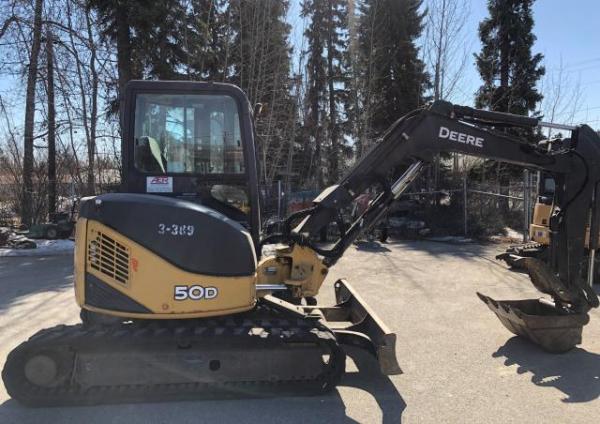
Legacy of John Deere and the 50D Excavator
John Deere, founded in 1837 and headquartered in Moline, Illinois, has evolved into a global titan in agricultural and construction machinery, reporting revenues exceeding US$9 billion and employing over 75,000 people in 2024. The 50D belongs to its D-Series compact excavators, renowned for blending rugged performance with operator comfort. John Deere’s D-Series machines, including the 50D, feature direct-injected diesel engines and thoughtful ergonomic design that extends service intervals while boosting uptime.
50D Specifications and Capabilities
The 50D was produced from 2009 to 2013, with a typical operating weight close to 4.7 tons (approximately 10,811 lb). Its powertrain includes a Yanmar 4TN88 four-cylinder diesel engine delivering around 38 kW (38 hp), enabling maximum digging reach of roughly 5.94 m (19 ft 6 in) and digging depth near 3.55 m (11 ft 8 in). Transport dimensions are compact enough for versatile deployment—about 5.46 m long, 2.01 m wide, and 2.51 m tall. Undercarriage features include 15.75-inch track shoes, a travel speed of about 2.8 mph, and ground clearance around 1.11 ft. Fuel tank holds approximately 18.5 gallons, with hydraulic fluid nearing 21.7 gallons.
Market Value and Availability
Used units of the 50D remain in demand, typically listing between US$33,900 and US$38,800 for 2009–2012 models, with earlier units priced between US$27,000 and US$32,000. By 2013, values often reached roughly US$38,800. Notable resale listings include a 2010 model with 2,070 hours and cab with air conditioning fetching around US$42,000, and a 2012 unit with 4,341 hours listed near US$22,450.
Practical Context and Stories
A landscaping contractor recounted renting a John Deere 50D for a residential backyard project. The noted comfort of the seat and visibility helped navigate tight tree-lined spaces, while its fuel efficiency kept costs low. Another operator working in utilities appreciated its compact size, which allowed access under power lines without sacrificing the needed reach of nearly 20 feet.
Recommendations and Use Considerations
Operators should consider: - Proper transport logistics: with overall dimensions around 5.5 m × 2.0 m × 2.5 m, the 50D fits on standard trailers.
- Fuel and hydraulic maintenance: keep both fluids clean and within spec to preserve performance.
- Undercarriage monitoring: track shoe wear affects ground pressure (~4.41 psi) and travel stability.
- Attachment compatibility: the 50D accepts quick-coupler attachments like breakers, thumbs, and augers, enhancing productivity.
Summary
The John Deere 50D midi excavator blends the legacy of Deere’s rugged reliability with modern operator comfort, delivering nearly 40 horsepower, an 11-foot digging depth, and a transportable size—all backed by a design that emphasizes serviceability and uptime. For contractors, farmers, and rental operators, it remains a relevant and versatile tool in tight-space excavation work.
|
|
|
|
| Why Did the Forklift Lose Its Lifting Power After a Hydraulic Oil Refill |
|
Posted by: MikePhua - 08-27-2025, 03:59 PM - Forum: Troubleshooting & Diagnosing
- No Replies
|
|
The Case of the S40XL-MIL Forklift
The Hyster S40XL-MIL is a rugged, military-grade forklift designed for reliability in harsh conditions. Originally developed for logistics operations in the U.S. military, this model was built to handle heavy loads with minimal electronic complexity. Its design dates back to the late 1980s, when Hyster was expanding its lineup of internal combustion counterbalance forklifts. The “MIL” suffix denotes its military specification, often featuring reinforced frames, simplified wiring, and non-computerized hydraulic systems for field serviceability.
Hyster, founded in 1929 in Portland, Oregon, became a global leader in material handling equipment by the mid-20th century. By the time the S40XL-MIL was introduced, Hyster had already sold hundreds of thousands of forklifts worldwide. The S40XL series itself was popular among industrial users for its 4,000 lb lifting capacity, robust mast design, and straightforward mechanical layout.
Symptoms of Hydraulic Dysfunction
In the case at hand, the forklift had been loaned out and returned with a critical issue: it had been operated until the hydraulic oil reservoir was completely depleted. After refilling the hydraulic fluid, the machine regained drive functionality but lost its ability to lift loads—except when in motion, and even then, the lift was jerky and inconsistent.
This symptom points to a classic case of air entrainment in the hydraulic system. When hydraulic oil runs dry, air is drawn into the pump and lines. Unlike oil, air compresses under pressure, causing erratic actuator behavior. In forklifts, this manifests as delayed or jerky lifting, reduced lifting power, and noisy operation.
Understanding Hydraulic Air Entrapment
Hydraulic systems rely on incompressible fluid to transmit force. When air enters the system, it disrupts this principle. The key issues caused by air include: - Spongy or delayed response: Air compresses before pressure builds.
- Jerky motion: Uneven pressure delivery to cylinders.
- Pump cavitation: Air bubbles collapse under pressure, damaging pump components.
- Reduced lifting force: Air reduces the effective pressure transmitted.
In older forklifts like the S40XL-MIL, which lack electronic diagnostics or self-bleeding systems, air removal must be done manually.
Bleeding the Hydraulic System
To restore proper lift function, the system must be purged of air. Here’s a recommended procedure tailored for non-computerized forklifts:
- Top off the hydraulic reservoir: Ensure fluid is at the correct level with the mast fully lowered.
- Cycle the lift slowly: Raise and lower the forks repeatedly without a load. This helps push air toward the reservoir.
- Hold at full extension: Keep the lift cylinder fully extended for 10–15 seconds to allow trapped air to escape.
- Inspect return lines: Look for bubbles or froth in the return stream—signs of air still circulating.
- Check filter and suction line: A clogged filter or cracked suction hose can draw air into the system.
- Let the machine sit: Overnight rest allows air to rise naturally to the reservoir.
In some cases, bleeding may require loosening fittings at high points in the system to release trapped air manually. Always follow safety protocols and depressurize before loosening any hydraulic connections.
The Role of Hydraulic Oil Quality
Not all hydraulic oils are created equal. Using the wrong viscosity or contaminated fluid can exacerbate air retention. For the S40XL-MIL, a high-quality ISO 46 hydraulic oil is typically recommended. Operators should ensure:- Clean fluid: Free of water, dirt, and metal particles.
- Correct viscosity: Too thin and it aerates easily; too thick and it resists flow.
- Proper temperature range: Cold oil traps air longer; warm oil bleeds faster.
A 2022 study by the Fluid Power Institute found that improperly matched hydraulic oil increased air retention time by up to 40%, especially in older systems with worn seals.
Field Anecdote from a Logging Operation
In a remote logging camp in British Columbia, a similar issue occurred with a vintage Clark forklift. After a hydraulic hose burst and drained the system, the crew refilled it but couldn’t get the lift to work. The mechanic, a retired millwright, used a trick he learned decades earlier: he parked the forklift on a slight incline, raised the forks, and let gravity assist the bleeding process. After several cycles and a few hours of rest, the lift returned to normal. This story underscores the value of field wisdom in troubleshooting legacy equipment.
Preventing Future Hydraulic Failures
To avoid similar issues, operators and owners should implement the following practices:- Daily fluid checks: Before operation, verify hydraulic oil level and inspect for leaks.
- Training for borrowers: If lending equipment, ensure users understand basic maintenance.
- Labeling and documentation: Place visible reminders near the reservoir and controls.
- Scheduled maintenance: Replace filters and inspect hoses every 250–500 hours.
According to a 2023 survey of industrial fleet managers, 68% of hydraulic failures were traced back to preventable causes like low fluid levels or neglected filter changes.
Conclusion
The loss of lift ability in the S40XL-MIL forklift after a hydraulic oil refill is a textbook example of air entrapment in a legacy hydraulic system. With careful bleeding, proper fluid selection, and preventive maintenance, such issues can be resolved and avoided. In an age of computerized diagnostics, the simplicity of older machines demands a return to hands-on troubleshooting and respect for field-proven techniques.
|
|
|
|
| Bobcat 873 Foot Pedal Jammed Stuck Lift Issue |
|
Posted by: MikePhua - 08-27-2025, 03:59 PM - Forum: Troubleshooting & Diagnosing
- No Replies
|
|
Machine Background and Problem Description
The Bobcat 873 skid steer loader is well-regarded for its robust design and versatility in landscaping, construction, and material handling. However, its foot pedals, which control lift and tilt functions through hydraulic linkages to the hydraulic control block, occasionally experience mechanical sticking or jamming.
An operator reported a situation where, after forcefully pressing the lift foot pedal to prevent an overhead hazard, the pedal became stuck firmly in the down position. Despite attempts to pry the linkage near the hydraulic block, there was no movement, although linkages appeared undamaged and without obstructions. This stuck pedal prevents return to neutral, disabling safe operation.
Potential Causes - Hydraulic Control Block Jamming: Components inside the hydraulic control block that receive pedal input (such as spool valves or actuators) may seize or bind due to contamination, corrosion, or lack of lubrication.
- Mechanical Linkage Binding: Although linkages may appear intact, small misalignments or bent pins can cause binding.
- Safety Lockouts: Sometimes a safety bar or lockout mechanism may interfere with pedal return if malfunctioning or incorrectly engaged.
- Hydraulic Pressure Lock: Residual hydraulic pressure in circuits can cause the pedal or related components to resist movement.
- Wear or Damage on Pivot Points: Worn bearings or bushings on pedal pivot assemblies can cause pedal hang-up.
Troubleshooting and Repair Recommendations- Inspect and clean the hydraulic control block area thoroughly to remove dirt, debris, or corrosion.
- Check pivot points, pins, and bushings on the pedal linkage for wear and replace as needed.
- Test for residual hydraulic pressure holding the system; relieve pressure by manually cycling auxiliary circuits or following manufacturer depressurizing procedures.
- Lubricate all linkage and pivot parts generously with appropriate grease.
- Release safety lockout bars fully and inspect switch mechanisms for proper function.
- If jamming persists, consider hydraulic control block disassembly and inspection for internal valve seizure or debris presence.
- Use penetrating oil on linkage joints to aid freeing stuck parts.
- If the pedal assembly or hydraulic valves are faulty, replace components using OEM parts.
Operational and Safety Notes- Avoid sudden heavy force on pedals; gentle, steady pressure minimizes risk of mechanical damage.
- Regular maintenance and cleaning of pedals and hydraulic control valves prevent seizing problems.
- Always ensure safety interlocks and lockouts function correctly before operation.
- Temporarily immobilized pedals can pose significant safety risks, so address immediately.
Glossary of Terms- Hydraulic Control Block: Assembly of valves and actuators controlling fluid flow to hydraulic cylinders.
- Spool Valve: Valve inside hydraulic control block directing flow based on control inputs.
- Lockout Bar: Safety feature preventing unintended hydraulic activation.
- Pivot Pin: Hinge or axle on which pedals or levers rotate.
- Penetrating Oil: Lubricant designed to loosen rusted or stuck mechanical parts.
Conclusion
A stuck foot pedal on a Bobcat 873, especially one that controls lift functions, is likely caused by a seized hydraulic control block, residual pressure, or linkage binding. Careful inspection, cleaning, lubrication, and pressure release form the first steps toward resolution. Preventive upkeep and cautious pedal actuation can avoid recurrence, safeguarding operator safety and machine functionality.
|
|
|
|
|



