| Welcome, Guest |
You have to register before you can post on our site.
|
| Forum Statistics |
» Members: 74
» Latest member: Tomo
» Forum threads: 47,413
» Forum posts: 47,419
Full Statistics
|
| Online Users |
There are currently 132 online users.
» 0 Member(s) | 118 Guest(s)
Ahrefs, Amazon, Applebot, Baidu, Bing, Claude, Google, MJ12, OpenAI, Petalbot, Semrush, Seznam, Sogou
|
| Latest Threads |
Identifying and Sourcing ...
Forum: Parts , Attachments & Tools
Last Post: MikePhua
01-07-2026, 06:29 PM
» Replies: 0
» Views: 454
|
Cat 931B Brake Parts
Forum: Parts , Attachments & Tools
Last Post: MikePhua
01-07-2026, 06:29 PM
» Replies: 0
» Views: 270
|
Choosing Between Cat 228,...
Forum: General Discussion
Last Post: MikePhua
01-07-2026, 06:28 PM
» Replies: 0
» Views: 472
|
Fix It or Part It Out
Forum: General Discussion
Last Post: MikePhua
01-07-2026, 06:27 PM
» Replies: 0
» Views: 336
|
Hydraulic Delay When Lowe...
Forum: Troubleshooting & Diagnosing
Last Post: MikePhua
01-07-2026, 06:27 PM
» Replies: 0
» Views: 416
|
Bale Chopper and Mulcher ...
Forum: General Discussion
Last Post: MikePhua
01-07-2026, 06:26 PM
» Replies: 0
» Views: 295
|
Mini UC Maintenance
Forum: General Discussion
Last Post: MikePhua
01-07-2026, 06:25 PM
» Replies: 0
» Views: 285
|
Locating Wiring Informati...
Forum: General Discussion
Last Post: MikePhua
01-07-2026, 06:24 PM
» Replies: 0
» Views: 320
|
Case Industrial Brown Sub...
Forum: Parts , Attachments & Tools
Last Post: MikePhua
01-07-2026, 06:23 PM
» Replies: 0
» Views: 261
|
Dirt Work in West Virgini...
Forum: Construction & Urban Infrastructure Forum
Last Post: MikePhua
01-07-2026, 06:23 PM
» Replies: 0
» Views: 351
|
|
|
| Resolving Overheating in the CAT 287B When Running a Forestry Mulcher |
|
Posted by: MikePhua - 08-29-2025, 10:29 PM - Forum: Troubleshooting & Diagnosing
- No Replies
|
 |
The CAT 287B and Its Cooling Demands
The Caterpillar 287B is a high-performance multi-terrain loader designed for demanding applications like land clearing, grading, and forestry work. Equipped with a turbocharged diesel engine and a closed-loop hydraulic system, it delivers strong torque and responsive control. However, when paired with high-demand attachments like forestry mulchers, the machine’s cooling system can be pushed to its limits.
Forestry mulchers are notorious for generating sustained hydraulic heat, especially during dense brush cutting or stump grinding. Even when the mulcher is a CAT-branded attachment, overheating can occur if the loader’s cooling system isn’t optimized for continuous high-flow hydraulic use.
Typical Overheating Symptoms
Operators report that after about an hour of mulching, the CAT 287B begins to overheat. This may manifest as: - Engine coolant temperature rising above safe thresholds
- Hydraulic fluid temperature climbing rapidly
- Warning lights or shutdown protocols activating
- Reduced power or sluggish response from the loader
These symptoms suggest that the cooling system is unable to dissipate the combined heat from the engine and hydraulic circuits under sustained load.
Key Areas to Inspect Before Replacing Coolant
Before draining and replacing coolant, several components should be inspected:- Thermostat Functionality
A faulty thermostat can restrict coolant flow, causing the engine to overheat even if the radiator is clean. Thermostats should open fully at the designated temperature (typically around 180–195°F). If stuck closed or partially open, coolant bypasses the radiator and recirculates hot.
- Radiator and Cooling Fins
Forestry work often clogs radiator fins with dust, wood chips, and debris. Even a thin layer of buildup can reduce airflow and heat exchange. Radiators should be pressure-washed regularly, and fins checked for bending or corrosion.
- Hydraulic Cooler Efficiency
The hydraulic cooler, often mounted adjacent to the radiator, must be clean and unobstructed. If the hydraulic fluid overheats, it can affect engine cooling indirectly due to shared airflow and thermal load.
- Fan Operation and Belt Tension
The cooling fan must spin at full speed under load. Worn belts or slipping pulleys can reduce airflow. Some models use variable-speed fans or hydraulic-driven fans—these should be tested for proper engagement.
- Coolant Level and Mixture
Low coolant or incorrect antifreeze-to-water ratio can impair heat transfer. A 50/50 mix is standard, but in extreme heat, a 60/40 mix may offer better protection. Always use coolant that meets CAT EC-1 specifications.
Hydraulic Heat and Attachment Load
Forestry mulchers demand high hydraulic flow—often 30–40 GPM at pressures exceeding 3,000 psi. This generates significant heat, especially when cutting dense material. If the loader’s hydraulic system lacks sufficient cooling capacity, fluid temperatures can exceed 180°F, contributing to overall machine overheating.
Solutions include:- Installing an auxiliary hydraulic cooler
- Using synthetic hydraulic fluid with higher thermal stability
- Reducing mulcher RPM during light-duty work
- Pausing periodically to allow system cooldown
Some operators retrofit their machines with larger coolers or fan upgrades to handle mulcher-specific workloads.
Comparing to Other Equipment Experiences
A similar issue was observed in Kubota front mowers used for municipal mowing. In that case, a failed thermostat caused overheating during long runs. Replacing the thermostat resolved the issue without needing a full coolant flush. This highlights the importance of diagnosing control components before assuming fluid failure.
Recommendations for Long-Term Reliability
To prevent recurring overheating:- Clean radiator and hydraulic cooler weekly during forestry operations
- Replace thermostat every 1,000 hours or if performance drops
- Monitor coolant and hydraulic temperatures with onboard diagnostics
- Use high-quality fluids rated for extreme duty cycles
- Consider upgrading cooling components if mulching is a primary task
If overheating persists despite these steps, a full system pressure test and flow analysis may be needed to identify internal restrictions or pump inefficiencies.
Conclusion
Overheating in the CAT 287B during forestry mulching is a known challenge, often caused by thermal overload in both the engine and hydraulic systems. By inspecting thermostats, cleaning cooling components, and optimizing hydraulic flow, operators can restore reliable performance and extend machine life. In high-heat, high-demand environments, cooling isn’t just a maintenance task—it’s mission-critical.
|

|
|
| Case 1835B Skid Steer Loader |
|
Posted by: MikePhua - 08-29-2025, 10:28 PM - Forum: General Discussion
- No Replies
|
|
Introduction
The Case 1835B skid steer loader is a compact, robust machine produced by Case between 1982 and 1987, evolving from earlier “Uni-Loader” designs. It emerged as a mid-range loader in Case’s lineup, blending manageable size with respectable lift capability—ideal for varied tasks in landscaping, construction, and agriculture. The development reflects Case’s ongoing adjustments to market demand following its acquisition of Universal Loader Company in the late 1960s.
Key Specifications
This model balances functionality and compact dimensions: - Dimensions & Weight
- Operating length: approximately 9 ft 4 in (2.84 m)
- Width: around 4 ft 6 in (1.37 m)
- Height: about 6 ft 8 in (2.05 m)
- Operating weight: roughly 4,543 lb (2.061 t)
- Performance & Capabilities
- Rated operating capacity: approximately 1,200 lb (544 kg)
- Travel speed: around 12 km/h, suitable for moderate transport and maneuvering
- Powertrain
- Engine options: Case 188D or 188G gasoline or diesel engines, delivering around 32 hp (23.9 kW)
- Hydraulic pump flow rated at about 15.5 gpm, sufficient for typical loader applications
Load and Hydraulic Performance
The loader boasts two double-acting lift cylinders that deliver the necessary hydraulic force to lift the rated load effectively. A lift capacity of roughly 1,200 lb with standard attachments made it a reliable performer in its class.
Parts, Attachments, and Support
Operators seeking to maintain or customize their 1835B loaders benefit from robust parts support:- Parts Availability
Replacement parts—from hydraulic pumps to undercarriages and tires—are accessible through suppliers offering new, rebuilt, or used components.
- Attachment Versatility
The loader features a universal quick-attach hitch. Popular attachments include buckets, grapples, trenchers, augers, pallet forks, sweepers, brush cutters, stump grinders, and dozer blades. Optionally equipped with high-flow hydraulics for more power-demanding tools.
Operator Tips and Solutions
To ensure optimal performance and longevity:- Label and Document During Disassembly
Carefully mark hoses or linkages to maintain correct routing and assembly, especially when accessing components beneath the loader frame.
- Prioritize High-Quality Replacements
Choose OEM or good aftermarket parts—especially for hydraulic and drivetrain components—to preserve durability and system integrity.
- Match Attachments to Hydraulics
Verify hydraulic flow when selecting attachments; high-flow setups unlock advanced tool compatibility.
- Budget for Routine Wear Items
Components like tires, seals, hoses, and filters wear naturally. Planning maintenance intervals based on operating hours helps avoid downtime.
Story from the Field
A landscaper once recounted saving a stalled job by sourcing a replacement lift cylinder for an 1835B originally manufactured in the mid-1980s. Since exhaust and hydraulic controls remained accessible from service manuals, the swap was completed in just a few hours—demonstrating the advantage of the model’s straightforward design and parts availability.
Summary
The Case 1835B skid steer loader strikes a balance of compact dimensions, moderate lift capacity, and engine power in a loader that remains supported decades after production ended. With dependable performance, a universal quick-attach system, and a supportive parts network, it continues to deliver value in diverse operational settings—whether on hobby farms, construction sites, or landscaping projects.
|
|
|
|
| Hydrostatic vs Torque Converter Drive in Earthmoving Equipment |
|
Posted by: MikePhua - 08-29-2025, 10:28 PM - Forum: General Discussion
- No Replies
|
|
Two Transmission Philosophies for Heavy Machinery
In the world of construction and earthmoving, the debate between hydrostatic drive systems and torque converter transmissions is more than technical—it’s cultural. Operators, mechanics, and manufacturers have long weighed the pros and cons of each system, especially in applications like dozers, loaders, and forestry machines. While both systems convert engine power into usable motion, they do so in fundamentally different ways, each with its own strengths and limitations.
Hydrostatic Drive and Its Precision Control
Hydrostatic transmissions use hydraulic pumps and motors to deliver variable speed and torque without shifting gears. The system relies on fluid pressure to drive the machine, allowing for infinite speed control and smooth directional changes.
Advantages: - Precise low-speed control, ideal for finish grading and tight maneuvering
- Instant forward/reverse switching without clutching
- Fewer mechanical components, reducing wear in some designs
- Excellent for applications requiring frequent speed changes or modulation
Hydrostatic systems are common in compact track loaders, small dozers, and forestry harvesters. For example, the John Deere 650K and Komatsu D39EX use hydrostatic drives to offer fingertip control during slope work and finish passes.
However, hydrostatic systems generate significant heat under load and can suffer from efficiency losses at higher speeds. They also require clean hydraulic fluid and regular maintenance of pumps, motors, and filters.
Torque Converter Drive and Its Load-Carrying Muscle
Torque converter transmissions use a fluid coupling between the engine and gearbox to multiply torque during acceleration. The converter allows slippage under load, giving the machine a “soft start” and absorbing shock. Once engaged, the transmission shifts through gears to deliver power efficiently.
Advantages:- Superior power transfer for heavy pushing and bulk material movement
- Proven durability in high-load applications like mining and quarrying
- Better fuel efficiency at higher travel speeds
- Easier to maintain in remote or rugged environments
Machines like the Caterpillar D6T and Case 1150M use torque converter drives to deliver consistent power during ripping, dozing, and long-distance travel. These systems are favored in applications where brute force and reliability matter more than finesse.
Comparing Performance in the Field
Operators often describe hydrostatic machines as “surgical” and torque converter machines as “brutal.” In finish grading, hydrostatic dozers can feather the blade with millimeter precision. In contrast, torque converter dozers excel at pushing full blades of wet clay or rock without bogging down.
One forestry contractor noted that his hydrostatic loader was perfect for maneuvering between trees, but struggled when climbing steep grades with a full bucket. After switching to a torque converter machine, he sacrificed some control but gained hauling capacity and fuel savings.
Maintenance and Longevity Considerations
Hydrostatic systems require:- Regular fluid changes (every 500–1,000 hours)
- Filter replacements and contamination control
- Monitoring of pump and motor wear
- Heat management through coolers and fans
Torque converter systems require:- Transmission fluid changes (typically every 1,000–2,000 hours)
- Clutch pack inspection and adjustment
- Occasional converter rebuilds after extended use
- Less sensitivity to fluid contamination
In remote areas, torque converter machines are often preferred due to simpler diagnostics and fewer specialized components. Hydrostatic systems may require dealer-level tools and expertise for troubleshooting.
Choosing the Right System for the Job
Recommendations based on application:- Finish grading, landscaping, and forestry: Hydrostatic
- Bulk earthmoving, mining, and road building: Torque converter
- Urban utility work with frequent direction changes: Hydrostatic
- Long-distance hauling or high-speed travel: Torque converter
Fleet managers often mix both types depending on jobsite demands. Some manufacturers offer hybrid systems that combine hydrostatic control with gear-based travel, aiming to capture the best of both worlds.
Conclusion
Hydrostatic and torque converter drives represent two distinct approaches to power transmission in heavy equipment. Hydrostatic systems offer unmatched control and responsiveness, while torque converters deliver raw power and proven durability. The choice depends on terrain, task, operator preference, and maintenance strategy. In the end, both systems move dirt—but how they do it defines the rhythm of the job.
|
|
|
|
| Skid Steer Plow Build |
|
Posted by: MikePhua - 08-29-2025, 10:27 PM - Forum: General Discussion
- No Replies
|
|
Introduction
Transforming a skid steer into a capable snow plow is a prime example of resourceful engineering, blending fabrication with hydraulic mechanics to repurpose available components. This versatile upgrade can save time and enhance functionality when clearing surfaces—especially in tight or complex spaces.
Skid Steer Origins and Attachment Heritage
Compact and agile, skid steer loaders emerged in 1957 when the Keller brothers built a three-wheeled loader to clear turkey farm manure . Melroe Manufacturing later refined the concept into a four-wheel loader and branded it “Bobcat,” which propelled widespread adoption . A billion-dollar industry today, annual global sales exceed 25,000 units . With such popularity, numerous attachments, including plows, were developed and sold by manufacturers such as Erskine Attachments in Minnesota .
DIY Plow Design Principles
Constructing a skid steer plow begins with attaching it to a quick-attach (QA) plate. A steel frame—typically built from ¼" to 5/16" plate or angle—supports the plow blade. Essential features include: - Floating hinge—A bottom hinge at the QA plate allows the blade to follow ground contour, reducing gouging and maintaining scraping efficiency .
- Mechanical float—Chain or similar linkage supports the blade when retracted, allowing the plow to tip under surface variations .
- Hydraulic power angle—Ideal for lateral blade control, using auxiliary circuits or the bucket curl circuit with additional hoses and fittings. This enables dynamic side-to-side adjustment .
One builder fabricated a lateral swivel feature and telescoping center link, enabling both float and controlled down pressure via bucket curl. He added a crossover valve for hose protection upon impact .
Real-World Insights
Seasoned fabricators highlight the difference between simple rigid setups and hydraulically functioning ones. For instance, one operator adapted a Fisher plow, adding a cushion valve for smoother operation, retained chain-based float, and used bucket curl for down pressure. All power-angle control came through the third hydraulic function for full hydraulic control .
Materials and Tools
Essential fabrication components include:- Quick attach (QA) plate, thick enough to bear load (5/16"–3/8").
- Structural steel (angle, tube, or channel) for frame.
- Recycled or new snow plow blade, preferably 7–10 feet wide.
- Hydraulic hoses, couplers (flat-face) and adapters matching skid steer standards.
- Welding tools, grinder, cutting torch, measuring and layout equipment.
Step-by-Step Build Plan- Mount the QA plate securely on the skid steer.
- Build a robust frame to support the plow blade and integrate a hinge for downward movement.
- Install chain or linkage to allow blade float; ensure the hinge allows both vertical movement and lateral tilt.
- Connect hydraulic lines: use aux hydraulics for angle if available, otherwise repurpose bucket curl cylinders and link them.
- Add cushion valve or crossover valve for shock protection.
- Test float, angle, and lift while fine-tuning chain length and cylinder response.
Performance Benefits- Custom float ensures smooth ground contact, minimizing surface gouging.
- Hydraulic angle improves efficiency and precision, enabling smoother snow creep and cleaner edges.
- Low-cost adaptation—many DIY builds cost under $1,500 by repurposing used truck plow blades .
Recommendations and Tips- Source a used plow blade to save cost—many available on classifieds. QA plates and hoses are standard and readily purchasable .
- Prioritize hydraulic angle control—manual-only designs are less efficient and labor-intensive .
- Test the blade on uneven terrain to ensure adequate float. Adjust chain and hinge flexibility accordingly.
- Integrate shear or cushion valves to protect hydraulic lines and arms during impacts.
Summary of Components- QA Plate
- Hinge-enabled frame
- Chain or linkage for float
- Hydraulic hoses and couplers
- Cushion or crossover valve
- Snow plow blade (7–10 ft recommended)
Conclusion
Building a skid steer plow transforms a loader into a multifunctional clearance machine—perfect for snow, loose surfaces, or light grading. By applying adaptable design elements—floating hinge, hydraulic angle, chain-supported float—DIY engineers can craft efficient, durable, and cost-effective plow attachments. Stories from the field show that even complex ideas like lateral swivel can be fabricated using basic steel stock and vehicle hydraulics. With growing skid steer markets and widely available parts, making your own plow is both practical and rewarding. If you'd like, I can help sketch a simplified diagram or checklist tailored to your skid steer model and available tools.
|
|
|
|
| Diagnosing Steering Lock-Up on the Terex 3172-31B Loader |
|
Posted by: MikePhua - 08-29-2025, 10:27 PM - Forum: Troubleshooting & Diagnosing
- No Replies
|
|
The Terex 3172-31B and Its Hydraulic Steering System
The Terex 3172-31B is a mid-sized wheel loader built for rugged earthmoving and material handling. Like many loaders of its class, it uses a hydraulic orbitrol steering system—also known as a steering control unit (SCU)—mounted at the base of the steering column. This system converts mechanical input from the steering wheel into hydraulic flow, directing fluid to the steering cylinders and enabling smooth articulation.
When functioning properly, the orbitrol allows proportional control in both directions. However, when internal components wear or bind, steering can become erratic, unpredictable, or even dangerous.
Symptoms of Steering Lock-Up
Operators have reported a specific failure mode: - Turning the steering wheel quickly causes it to lock solid
- Reversing the steering direction with force temporarily frees the system
- Slow, deliberate steering works normally in both directions
- The issue occurs symmetrically—both left and right turns are affected
This behavior suggests a mechanical or hydraulic restriction inside the orbitrol unit, rather than external cylinder binding or linkage interference.
Understanding Orbitrol Steering Units
Orbitrols are rotary valve assemblies that meter hydraulic flow based on steering input. Inside the unit:- A spool and sleeve rotate with the steering wheel
- Internal springs and centering pins maintain neutral position
- Check valves and pressure reliefs regulate flow and protect against overload
- Seals and bushings guide movement and prevent leakage
When the spool binds or the centering mechanism fails, the unit may lock mid-turn or resist rapid input. This is especially common in older machines where fluid contamination or wear has degraded internal tolerances.
Likely Causes of Steering Lock-Up
Based on the symptoms, the most probable causes include:- Worn or scored spool and sleeve surfaces
- Broken centering springs or pins
- Internal debris from pump or hose degradation
- Fluid contamination causing sticky movement
- Pressure imbalance due to faulty check valves
Because the steering works when turned slowly, mechanical interference is unlikely. Instead, the orbitrol may be experiencing hydraulic lag or internal friction that worsens with speed.
Inspection and Repair Strategy
To diagnose and repair:- Remove the orbitrol unit from the steering column
- Disassemble carefully, noting spring orientation and spool alignment
- Inspect spool and sleeve for scoring, galling, or wear
- Check centering springs and pins for breakage or distortion
- Clean all components with lint-free cloth and hydraulic-safe solvent
- Replace seals, springs, and worn parts using a rebuild kit if available
- Reassemble with proper torque and alignment
If the orbitrol is beyond repair, replacement may be necessary. OEM units can be expensive, but remanufactured or cross-compatible orbitrols from brands like Eaton or Char-Lynn may offer cost-effective alternatives.
Preventive Measures and Fluid Health
To prevent future steering issues:- Change hydraulic fluid at recommended intervals
- Use fluid with proper anti-wear and anti-foaming additives
- Install inline filters to catch debris before it reaches the orbitrol
- Inspect hoses for internal delamination or shedding
- Avoid overloading the steering system with excessive articulation under load
One operator shared that after rebuilding his orbitrol and flushing the system, steering returned to normal—and the loader felt “like new” during tight maneuvers.
Conclusion
Steering lock-up on the Terex 3172-31B is most likely caused by internal orbitrol wear or contamination. While the issue may seem severe, it’s often repairable with careful disassembly and inspection. By understanding the mechanics of hydraulic steering and maintaining fluid health, operators can restore precise control and extend the life of their loader’s steering system. In machines built to move mountains, steering shouldn’t be a fight—it should be a fingertip command.
|
|
|
|
| Caterpillar M310MY Hydraulic Hose Routing Explained |
|
Posted by: MikePhua - 08-29-2025, 10:26 PM - Forum: General Discussion
- No Replies
|
|
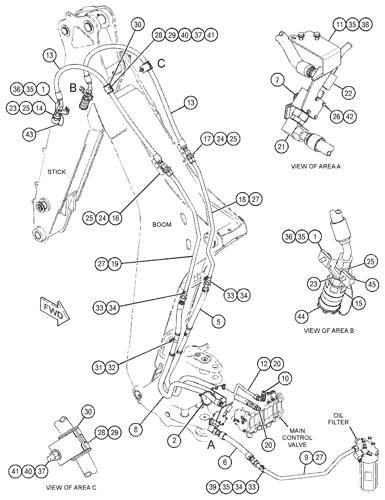
Introduction
The Caterpillar M310MY—part of Cat’s renowned backhoe loader lineup—was introduced in the late 1990s as a dependable workhorse tailored for construction and utility tasks. With its intuitive controls and compact footprint, it became a staple on job sites worldwide. A critical yet often underappreciated system powering its functionality is the hydraulic hose network. These flexible conduits channel pressurized fluid between key components like pumps, control valves, cylinders, and stabilizer arms, enabling the loader, boom, and hydraulic attachments to operate in unison.
Hydraulic Hose Diagram Overview
The provided schematic details the hydraulic hose layout of the M310MY. It maps each line's path—including pressurized supply lines, return/drain lines, and pilot-control circuits—by illustrating their connections to valves and actuators. Although this isn’t an OEM reproduction, the graphic clarifies how hoses weave around the machine’s frame, connecting functional groups and ensuring the hydro-powered mechanics translate smoothly to movement.
This visualization highlights critical line groupings: - Supply and return routing: High-pressure lines feed the main control valve and cylinders; return lines channel back to the reservoir.
- Pilot circuit layout: Special pilot hoses handle low-pressure signals that guide valve operations.
- Component grouping: Separate hose assemblies serve the loader arms, backhoe boom, stabilizers, and other functions, organizing the network for clarity and maintenance.
Key Technical Highlights- Pressure conduits: High-pressure hoses, often braided and rated for several thousand psi, deliver fluid to the boom and bucket cylinders.
- Pilot hoses: Carry control signals to diverter and return valves; crucial for operator-intended motion.
- Return lines: Larger, low-pressure hoses ensure fluid returns efficiently to the tank, reducing turbulence and heat buildup.
- Clamps and guides: Routing is maintained through clamps and brackets to prevent abrasion, chafing, and kinks—vital for long-term hose integrity.
Typical Hose Routing Paths- Loader arm circuit: High-pressure supply runs from the main pump to the loader control valve, then to lift and tilt cylinders, with return lines forming a loop back to the reservoir.
- Backhoe boom circuit: Separate hoses run from the main valve through the swing frame to boom and stick cylinders, with return paths laid out to the tank.
- Stabilizer routing: Smaller pilot hoses and main supply lines go down to each stabilizer cylinder, ensuring they expand or retract evenly.
- Pilot lines: Color-coded or marked as L1–L4 in some models, pilot hoses feed control logic lines back to the joystick valves.
Practical Tips and Solutions- Labeling hoses during disassembly: Number supply, return, and pilot hoses during maintenance to preserve routing order.
- Use OEM-quality replacement hoses: Caterpillar manufactures its own hoses with multi-layer reinforcement and abrasion-resistant outer covers .
- Routine inspection: Scan lines for kinks, chafing, or swelling; replace immediately if any wear appears.
- Cleanliness matters: Before reconnecting, wipe fittings and check for grit to avoid introducing contaminants into the hydraulic system.
- Plan for early replacements: High-flex zones prone to repeated bending—like near joysticks and swing frames—typically require preventive replacement after 5,000–8,000 operating hours.
Operator Anecdote
One M310MY operator recalled a memorable winter shutdown: cold-weather stiffening caused a small leak at a hose bend near the swing frame. Because the routing was clearly labeled and clamped, the team quickly replaced the damaged segment and resumed work with minimal downtime. Good hose layout and clear routing made the repair quick and precise—underscoring the importance of design clarity.
Conclusion
Understanding and maintaining the hydraulic hose architecture of the M310MY is fundamental to reliability and performance. This diagram serves not just as a map but as a guide for efficient repairs, preventive maintenance, and system durability. Proper routing, OEM parts, and thoughtful upkeep keep this loader running strong—one hose at a time.
|
|
|
|
| End Dump Spewing Oil |
|
Posted by: MikePhua - 08-29-2025, 10:26 PM - Forum: General Discussion
- No Replies
|
|
Introduction
An end-dump truck that suddenly spews oil is more than an annoyance — it’s an immediate safety, environmental and downtime problem. This article walks through the likely causes, diagnostic steps, repair options, preventive measures and practical recommendations so you (or your shop) can get the unit back to work fast and with less drama. The writing blends technical explanation, a short field anecdote and actionable checklists so it reads naturally while still being precise.
What “spewing oil” usually means
When an end-dump “spews” oil owners report one of three visible behaviours: a spray or stream of fluid from the rear or underbody; a plume of fluid from the dump body area while raising or lowering; or continuous leakage that becomes a trail behind the truck. That fluid can be hydraulic oil, engine oil, transmission fluid, gear oil from axles, or even PTO/auxiliary system oil — identifying which fluid is critical to an effective fix.
Quick field story
A municipal crew found a 10-ton end dump leaving dark ribbons of oil on roadways every morning. The first guess was a cracked hydraulic hose. The real culprit turned out to be a failed tailgate lock cylinder that had worked loose, squirting hydraulic fluid onto the chassis during repeated tailgate kicks. The repair: replace the cylinder, re-route and clip the hose to prevent chafing, and fit a small splash shield — total downtime one afternoon, no environmental citation, and a grateful site foreman.
Likely causes and what to look for - Burst or chafed hydraulic hose — visible spray, often under pressure when the hoist is operated. Look for ragged rubber, abrasion marks at clamps, or a puncture.
- Loose or failed fittings and couplers — drips become sprays under lift pressure; fittings may be finger-tight or cross-threaded.
- Tailgate cylinder failure or broken pin — oil appears around the tailgate area and may be correlated with tailgate movement.
- Hoist cylinder seal failure — fluid loss during lift/lower cycles; external seepage around cylinder rod or gland.
- PTO/aux pump leak — oil at the midship or underbody, often near the transmission/PTO area; may drip only when PTO engaged.
- Axle or differential seal failure — thicker gear oil trail from axle housing, typically slower but heavy contamination of rear tires/wheels.
- Overfilled reservoir or foaming — oil expelled from breather or overflow ports during hydraulic system heat cycles.
- Blocked return/breather or failed reservoir cap — pressure builds and forces oil out of weakest point.
- Improper repairs or incorrect hose spec — hoses rated too low for system PSI, or use of wrong fittings.
Diagnostics checklist (fast triage)- Visual inspection while another tech slowly cycles the hoist and tailgate (observe safe distance).
- Smell and touch a small sample (wear gloves) to identify fluid type: thin (hydraulic/transmission), heavier and darker (gear/axle), or oily with fuel smell (contaminated).
- Clean the suspected area, operate the system, watch for fresh seepage — use cardboard or shop rags so you can pinpoint source.
- Check hydraulic reservoir level and sight gauge; note any rapid drop correlated to operation.
- Inspect hoses for rubbing points, clamps, or kinks; tug fittings to check tightness (with system depressurized).
- Check PTO engagement behavior and linkage for oil at PTO shaft or pump.
- Use dye or UV dye in hydraulic reservoir for tricky leaks (performed by experienced tech).
- If smoke or flu-like vapors are present, stop and ventilate — some hot oil mists are hazardous.
Repair options and practical steps- Minor hose/fitting replacement
- Replace with OEM-spec or equal high-pressure hose (correct inner diameter, rating for operating PSI and temp).
- Replace clamps with cushioned clamps and add split-loom or abrasion sleeves where hoses contact structure.
- Torque fittings to manufacturer spec; where applicable use backing washers or thread sealant per OEM.
- Cylinder seal replacement
- Lower and lock out the hoist before servicing.
- Remove cylinder, bench-disassemble, replace seals and rod if scored. Reassemble with correct lubrication and torque.
- Reservoir and breather service
- Clean or replace breather cap; ensure reservoir venting is unobstructed.
- Check fluid level and top with correct fluid; purge air from system per OEM procedure.
- Tailgate hardware
- Replace worn pins, bushes and leaking tailgate cylinders; add hose clips and splash shields.
- Axle/diff seal repair
- Drain differential, replace axle seals and repack bearings if necessary; renew fluids to spec.
- Preventing recurrence
- Reroute hoses away from moving parts; secure with cushioned clamps every 12–18 inches; install guard plates on common chafe points.
Parts, tools and materials to have ready- Correct spec hydraulic hoses (lengths and crimped ends) and fittings.
- Seal kits for hoist, tailgate and PTO cylinders.
- Torque wrench, hydraulic pressure gauge, hose cutters, crimper (or access to hose shop), spill containment kit, UV leak dye and UV lamp, rags, disposable gloves.
- Replacement filters and correct hydraulic fluid (keep OEM spec sheet handy).
Environmental and safety considerations- Hydraulic oil on roads or soil is an environmental hazard; immediate containment and cleanup are required to avoid fines and reputational damage.
- Always use absorbent kits and proper disposal methods for contaminated rags and soil.
- Lockout/tagout the hoist and PTO before working. Depressurize hydraulic circuits and support raised beds with mechanical props when doing under-bed repairs.
- Record and report spills per company and local regulations.
Maintenance schedule and recommended intervals- Daily: walkaround check for visible leaks, hose chafe, fluid levels.
- Weekly: inspect hose clamps, check tailgate pins, look for seepage around cylinders.
- Monthly: full underbody inspection, check breather caps, verify reservoir fluid cleanliness.
- Every 1,000–2,000 hours: change hydraulic filters and inspect internal reservoir/cooler for sludge (follow OEM).
- Keep a repair log: track hours at failure, replacement part serials and who performed the repair to spot repeat failures.
Cost and downtime considerations- Hoses and fittings replacement: low to moderate cost (parts and labor typically a few hundred dollars) and can often be done same day.
- Cylinder seal packs and bench rebuilds: moderate cost and usually 1–2 days downtime depending on parts availability.
- Differential or axle seal jobs: higher cost, may require axle removal — plan for longer downtime and parts lead time.
- Preventive spend on clamps, guards and routing is relatively small and often prevents a much larger bill and regulatory headaches.
Terminology (quick glossary)- PTO — power take-off: device that transmits engine power to auxiliary pumps.
- Hoist cylinder — hydraulic cylinder that raises/lowers the dump body.
- Breather — the reservoir vent that equalizes pressure; can be a drainage/vent cap or valve.
- Rod gland — the part where the cylinder rod exits; contains seals and wipers.
- Return line — low pressure line carrying oil back to the reservoir.
- Pressure line — high pressure line from the pump to the actuators.
Data-oriented tips- Typical working pressures for dump hoist hydraulics are in the thousands of PSI; use hoses and fittings rated above the system maximum and replace any hose older than factory lifespan or showing abrasion.
- Studies and fleet reports show that operator fault and chafing account for a large share of field hydraulic failures; secure routing and operator training can reduce hydraulic leak incidents by a marked percentage in large fleets.
- A simple walkaround taking 3–5 minutes per shift often prevents catastrophic failures that cost many times more in repairs and lost uptime.
Practical recommendations- Always isolate and lock out hydraulic systems before repair.
- Replace only with OEM-equivalent components or better; do not down-rate pressure ratings to save cost.
- Add routine hose routing audits to your preventive program and use cushioned clamps and protective sleeves at wear points.
- Keep a calibrated pressure gauge and train techs to use it — many leaks only show under load and will be missed at rest.
- Consider adding a small fixed splash shield or deflector plate behind the hoist and tailgate to protect hoses and fittings from kicked debris.
Conclusion
An end dump spewing oil is fixable — and almost always preventable with disciplined inspection and modest hardware improvements. Finding the right source quickly (hose, fitting, cylinder, PTO or axle) reduces environmental exposure, downtime and repair costs. Equip your crew with the right diagnostic checklist, stock the common parts, and add a few protective measures to the truck to transform an avoidable failure into a short, routine repair. If you want, I can produce a printable inspection checklist tailored to your fleet or a step-by-step repair sheet for common leak types.
|
|
|
|
| Evaluating a 1987 Ford L9000 Single Axle Dump for Light Equipment Hauling |
|
Posted by: MikePhua - 08-29-2025, 10:25 PM - Forum: General Discussion
- No Replies
|
|
The L9000 Platform and Its Vocational History
The Ford L9000 series was a staple in North American vocational trucking throughout the 1980s and early 1990s. Built for durability and simplicity, it was commonly spec’d for dump, mixer, and municipal applications. The 1987 model year saw continued use of mechanical drivetrains and straightforward electrical systems, making these trucks popular among owner-operators and small contractors. With a gross vehicle weight rating (GVWR) typically ranging from 35,000 to 52,000 lbs depending on axle configuration, the L9000 could be configured as a single or tandem axle unit.
The truck in question features a single rear axle, a 9-speed manual transmission, and an 8.3L diesel engine rated at 240 horsepower. It’s equipped with a 25-ton pintle hitch and air brakes to the rear, suggesting it was used for light towing and material hauling. With 300,000 miles on the odometer and an asking price of $8,500, it sits in the realm of budget-friendly work trucks—but not without caveats.
Engine Identification and Performance Considerations
The 8.3L engine is most likely a Cummins ISC, as Ford did not produce an 8.3L diesel. Ford’s own offerings at the time included the 6.6L and 7.8L Brazilian-built New Holland diesels, which were known for reliability but lacked the torque and parts support of Cummins units. The Cummins 8.3L, on the other hand, was widely used in vocational trucks, buses, and agricultural equipment, offering: - Horsepower range: 210–300 hp depending on fuel settings
- Torque: Up to 800 lb-ft at peak rating
- Mechanical injection (pre-1998), simplifying diagnostics
- Broad parts availability across North America
However, at 240 hp, the engine is considered underpowered for tandem axle configurations or heavy towing. For single axle applications, it’s adequate for hauling a backhoe or small dozer, but not ideal for pulling a 20-ton tag trailer with a full-size excavator.
Transmission and Towing Dynamics
The 9-speed transmission offers flexibility for mixed terrain and moderate grades. With a 25-ton pintle hitch and air to rear, the truck is capable of towing equipment trailers, provided tongue weight and braking are properly managed.
Key towing considerations:- Tongue weight should not exceed 10–15% of trailer weight
- Air brakes on the trailer must be fully functional and properly synced
- Suspension type affects ride and stability—Chalmers and Hendrickson walking beam offer different dynamics
- Single axle trucks are more sensitive to tongue weight, often “seesawing” under load
Operators have reported that single axle trucks with 4,000–5,000 lbs of tongue weight can tow reliably, but braking and stability become critical. A tandem axle truck with a larger engine (10–14L displacement) is preferred for hauling 20-ton trailers with excavators like the Deere 160 or Case 210.
Mileage and Maintenance Expectations
At 300,000 miles, the truck is approaching the upper limit of its service life without a major rebuild. If the previous owner maintained it meticulously—regular oil changes, valve adjustments, cooling system flushes—it may still have life left. However, buyers should expect:- Potential injector or pump wear
- Transmission clutch or synchro fatigue
- Brake system overhaul
- Steering and suspension bushing replacement
- Hydraulic ram packing and hoist pin wear
A thorough inspection by a diesel technician is recommended before purchase. Paint and cosmetics can be deceiving; mechanical integrity is what counts.
Common Pitfalls in Used Dump Trucks
Dump trucks are notorious for hiding wear beneath fresh paint. Key areas to inspect include:- Hoist cylinder seals and packing
- Frame cracks near the dump pivot
- U-joints and driveline alignment
- Brake chamber condition and air line routing
- Electrical system grounding and relay function
Many older trucks receive “DuPont makeovers”—a fresh coat of paint to mask rust and wear. Buyers should look past aesthetics and focus on mechanical health.
Recommendations for Prospective Buyers
Before committing to a truck like this:- Verify engine model and serial number to confirm it’s a Cummins
- Inspect the dump body for structural integrity and hinge alignment
- Test brake system under load, including trailer air supply
- Check for signs of oil dilution, coolant leaks, or blow-by
- Review maintenance records if available
- Bring a mechanic or experienced operator to assist with evaluation
If the truck will be used for occasional hauling—5,000 to 10,000 miles per year—it may be a worthwhile investment. For daily use or heavy towing, a tandem axle with higher horsepower is a safer bet.
Conclusion
The 1987 Ford L9000 single axle dump with a Cummins 8.3L engine and 9-speed transmission offers a budget-friendly entry into light equipment hauling. While underpowered for heavy-duty towing, it can handle backhoes and small dozers with proper trailer setup. With 300,000 miles, buyers must weigh the cost of potential repairs against the asking price. In the world of used vocational trucks, the best deals are found not in the paint—but in the parts that still work.
|
|
|
|
| Pintle Hitch Fundamentals |
|
Posted by: MikePhua - 08-29-2025, 10:25 PM - Forum: Parts , Attachments & Tools
- No Replies
|
|
A pintle hitch is a rugged towing setup that uses a hook (the pintle) on the towing vehicle paired with a robust loop, known as a lunette ring, on the trailer. This hook-and-ring system allows for high towing capacity and exceptional articulation—making it ideal for off-road, construction, military, and heavy-duty applications.
Origins and Evolution
The pintle hitch has a surprisingly long history. It originated as a simple pin-based coupling in the era of horse-drawn wagons, allowing for easily detachable trailers with a degree of pivot motion. As motor vehicles replaced horse power, pintle hitches evolved to handle increased load and speed. The later introduction of the reinforced lunette ring enhanced flexibility and maintained security, particularly useful in rugged or military conditions.
Advantages in Heavy-Duty Use - High load capacity: Examples include pintle hooks rated for up to 60,000 lb or even 100,000 lb gross trailer weight.
- Robust and durable: Made from drop-forged steel or tough alloys with corrosion-resistant coatings for long life.
- Superior articulation: The hook-and-ring system allows greater pitch and yaw, enabling smooth towing over rough terrain.
- Secure hookup: With locking arms and safety pins, pintle hitch connections resist unintended disconnection even under stress.
Real-World Use and Anecdotes
In military and construction environments, pintle hitches are indispensable. One operator shared that heavy trailers on rough terrain simply bounce too much with soft ball-hitches—and the pintle design delivers the robustness needed to handle those punishing conditions.
Manufacturers such as Buyers Products offer swivel-style pintle hooks meeting military specifications, capable of handling 100,000 lb loads—though operators are advised to reduce that load by 25% when off-roading due to increased stress during articulation. Premier Manufacturing provides a range of couplings—for instance, the 235SM swivel coupling offers 60,000 lb capacity and improved vibration dampening for smoother operation.
Key Components and Configurations
Pintle hitch systems have a few essential parts:- Mounting plate or shank: Either bolted on or receiver-mounted for sturdy attachment.
- Hook or hook-and-ball: Traditional hook for lunette rings, or combo versions include a ball for conventional trailer tongues.
- Locking arm with retainer pin: Secures the connection and prevents disengagement.
Specifications and Examples- 30-Ton Bolt-On Pintle Hook: Drop-forged steel, powder-coated finish, supports up to 60,000 lb trailer weight with 15,000 lb vertical load.
- Draw-Tite Bolt-On Pintle Hook: 60,000 lb gross trailer weight, 6,000 lb tongue weight, includes hardware for easy mounting.
- Premier Coupling Series:
- Models carrying up to 100,000 lb (e.g., 1200 series)
- Swivel designs like 135NT for smooth off-road towing
- Slack-reducing models to minimize trailer surge and provide enhanced control
Recommendations- Match capacity: Choose a pintle whose rated towing and vertical load exceed your requirements—preferably with a safety margin of 20–30%.
- Consider terrain: Opt for swivel or slack-reducing models if frequently towing over rough ground.
- Ensure maintenance: Regularly inspect locking arms and pins; corrosion-resistant finishes help with long-term durability.
- Plan for versatility: Combo hitches provide flexibility when towing trailers with different coupling styles.
Summary
Pintle hitches have stood the test of time—from simple horse-drawn beginnings to essential tools in modern heavy-duty transport. Their hook-and-ring design offers unmatched durability, flexibility, and safety in demanding environments. Whether in military convoys, construction zones, or agricultural operations, they continue to be the go-to solution when nothing less than reliable, heavy-duty towing will do.
|
|
|
|
| Servicing the Transmission on a Caterpillar 955L Track Loader |
|
Posted by: MikePhua - 08-29-2025, 10:24 PM - Forum: Troubleshooting & Diagnosing
- No Replies
|
|
The 955L and Its Transmission Architecture
The Caterpillar 955L track loader was introduced in the mid-1970s as a successor to the 955K, offering improved hydraulic performance, enhanced operator comfort, and a more robust transmission system. Powered by the Cat 3304 engine, the 955L featured a powershift transmission coupled with a torque converter, allowing smooth directional changes and gear shifts under load. This configuration made it ideal for excavation, stockpiling, and general-purpose loading in construction and quarry environments.
The transmission system is housed beneath the operator platform and protected by a belly pan. Servicing this component requires careful attention to access points, fluid types, and drain procedures.
Accessing the Transmission Drain Without Removing the Belly Pan
One of the most common questions during routine maintenance is whether the transmission fluid can be drained without removing the belly pan. On most Caterpillar machines of this era, including the 955L, the belly pan includes access holes or removable covers specifically designed for fluid servicing.
These access points are often circular or rectangular cutouts aligned with the drain plug locations. In some cases, a small steel plate must be unbolted to reach the plug. This design allows technicians to perform fluid changes without lifting the entire belly pan—a task that would otherwise require hoisting equipment and significant downtime.
Understanding the Drain Valve Mechanism
Caterpillar transmissions and hydraulic tanks from this period often use a two-stage drain valve system. After removing the drain plug, a threaded 1-inch pipe nipple can be screwed into the valve body to open the internal drain mechanism. This approach prevents accidental draining and allows controlled fluid release.
Steps for draining: - Locate the access hole in the belly pan
- Remove the protective cover if present
- Unscrew the drain plug using a socket wrench
- Thread a 1-inch pipe nipple into the valve body to open the internal drain
- Allow fluid to drain fully into a clean container
- Inspect fluid for metal particles or discoloration
- Replace plug and cover after draining
Always use a new sealing washer or gasket when reinstalling the drain plug to prevent leaks.
Recommended Fluid and Filter Replacement Intervals
For the 955L transmission:- Fluid type: Caterpillar TDTO (Transmission Drive Train Oil) SAE 30 or equivalent
- Capacity: Approximately 8–10 gallons depending on configuration
- Change interval: Every 500 hours or annually, whichever comes first
- Filter replacement: Every fluid change or sooner if contamination is suspected
Using the correct fluid is critical for maintaining clutch pack integrity and torque converter performance. Substituting with engine oil or hydraulic fluid can lead to premature wear and erratic shifting.
Signs of Transmission Wear and Contamination
During servicing, technicians should inspect the drained fluid for signs of internal wear:- Metallic sheen or flakes: Indicates clutch or gear wear
- Burnt odor: Suggests overheating or fluid breakdown
- Milky appearance: May indicate water intrusion from a failed cooler
- Sludge or varnish: Points to extended service intervals or poor fluid quality
If contamination is found, consider flushing the transmission with clean fluid before refilling. Also inspect the transmission breather and cooler lines for blockages or leaks.
Field Anecdotes and Practical Advice
One retired quarry mechanic shared that on older Cat loaders, belly pans were often caked with mud and rock dust, obscuring access holes. He recommended pressure washing the underside before attempting any fluid service. Another operator noted that using a magnetic drain plug helped catch early signs of gear wear, saving him from a costly rebuild.
In cold climates, preheating the transmission fluid with a block heater or running the machine briefly before draining can improve flow and reduce viscosity-related delays.
Conclusion
Servicing the transmission on a Caterpillar 955L is straightforward when access holes and drain valve mechanisms are understood. With proper tools, clean work practices, and attention to fluid condition, operators can extend the life of their powershift system and maintain reliable performance in demanding environments. In machines built for heavy lifting and constant motion, clean oil is the quiet force that keeps everything moving.
|
|
|
|
|



